
By Amy Krzyzek, GC Intern
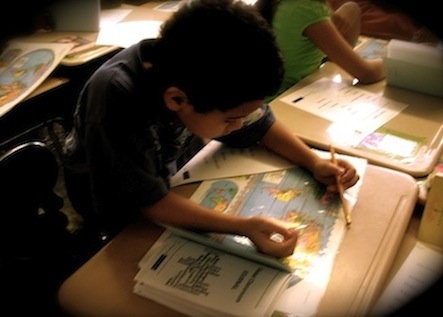
This week, I accompanied Irish Global Guide Darragh to PS 75 in the South Bronx. Darragh, a PhD student in Theater at Colombia, did not hold a “typical” workshop; rather than a PowerPoint, Darragh led several engaging activities.
First, he directed a simple play about the legendary sea journey of St. Brendan of Clonfert. Darragh taught students Gaelic words and phrases to use in the performance, including America, Ireland, Hello, Goodbye, What is your name?, and Whale. In the story, St. Brendan lands on an island which turns out to be a whale. Then, he and his companions scurry away from the island and eventually find America.
Then, Darragh led an excerpt of the song “Molly Malone,” a popular anthem in Dublin. He explained the song is about a woman who sells seafood on the street, and students connected this to the food vendors here in New York City.
In Dublin's fair city,
where the girls are so pretty,
I first set my eyes on sweet Molly Malone,
As she wheeled her wheel-barrow,
Through streets broad and narrow,
Crying, "Cockles and mussels, alive, alive, oh!"
"Alive, alive, oh,
Alive, alive, oh",
Crying "Cockles and mussels, alive, alive, oh".
Finally, Darragh introduced students to Ogham stones--stones where people in past centuries used to write the Old Irish language. Students practiced writing their names with the alphabet, finding it challenging that some letters in our alphabet (J, K, Y) did not exist in the Ogham alphabet.
Students thanked Darragh for a wonderful workshop by shouting "Slán!", the Gaelic word for goodbye.
Sunday, February 7, 2010
Thursday, January 14, 2010
Learning about Stereotypes at PS 75
Russia and Stereotypes
By Amy Krzyzek, GC Intern
Last month, Anna, a Global Guide from Russia, gave a presentation about stereotypes to two classes (4th and 5th grades) at PS 75 in the South Bronx. She mentioned four main stereotypes people have about Russia: cold weather, Russian bears, the Russian mafia, and Russian dolls, called matreshka.


Anna explained to the classes that stereotypes aren’t necessarily bad—they are just not the “whole picture.” As an activity, Anna had students draw a symbol that represents their country. Students represented the United States with pictures of chocolate chip cookies, traffic jams, Barack Obama, and the Statue of Liberty. Students from the Dominican Republic drew motorcycles, beaches, and family members. A student from Yemen drew a beautiful hilly landscape. Overall, students found it very difficult to portray their country with just one image.


This workshop reminded me of the value of the Global Classroom program. When we learn about other cultures—in books, on TV, and even in social studies class— we must be careful not to essentialize others. We all have the tendency to attach a few characteristics to particular countries or cultures, assuming that’s enough. By sending global guides— real citizens of foreign countries—into classrooms, students are exposed to social studies beyond simplistic stereotypes.
By Amy Krzyzek, GC Intern
Last month, Anna, a Global Guide from Russia, gave a presentation about stereotypes to two classes (4th and 5th grades) at PS 75 in the South Bronx. She mentioned four main stereotypes people have about Russia: cold weather, Russian bears, the Russian mafia, and Russian dolls, called matreshka.
Anna explained to the classes that stereotypes aren’t necessarily bad—they are just not the “whole picture.” As an activity, Anna had students draw a symbol that represents their country. Students represented the United States with pictures of chocolate chip cookies, traffic jams, Barack Obama, and the Statue of Liberty. Students from the Dominican Republic drew motorcycles, beaches, and family members. A student from Yemen drew a beautiful hilly landscape. Overall, students found it very difficult to portray their country with just one image.
This workshop reminded me of the value of the Global Classroom program. When we learn about other cultures—in books, on TV, and even in social studies class— we must be careful not to essentialize others. We all have the tendency to attach a few characteristics to particular countries or cultures, assuming that’s enough. By sending global guides— real citizens of foreign countries—into classrooms, students are exposed to social studies beyond simplistic stereotypes.
Subscribe to:
Posts (Atom)
