
The MDGs and ME at the ACORNSchool for Social Justice
By Amy Kryzek, GC Intern
Global Classroom is thrilled to be working with ACORNSchool for Social Justice in Brooklynth on an exciting new program about the Millennium Development Goals (MDGs) to three 10 grade classes.
For the first workshop, Japanese Global Guide Miki O’Halloran presented an introduction to the MDGs. First, students discussed what people need to survive and thrive. To survive, students suggested people need the unity of others, love, shelter, food, and motivation. To thrive, students suggested education, people skills, a job, an open mind, dedication, perseverance, imagination, knowledge, and goals. Miki then introduced the term “quality of life” and students recognized that this word means different things to different people. For instance, one student noted, “Quality of life is different because some people live in mansions while other people live on the streets.”
//www.youtube.com/watch?v=v3p2VLTowAA). After seeing statistics about diseases, poverty, and inequality, student’s reactions ranged from sympathetic, to angry, to an appreciation of being informed. "I can't believe I didn't know this was reality!" one student reflected. Then, without watching the end of the video where the goals are named, students had to guess the eight goals in groups—most groups were able to think of at least six!
Miki returned the next week to discuss her home country—Japan—and how it is aiding in achieving the Millennium Development Goals. For this second workshop, Miki gave students a cultural context to help them understand Japan’s approach to aid. She began by introducing students to the dichotomy between traditional and modern culture in Japan. After showing a short video of scenes from Tokyo that juxtaposed ancient structures with modern high-rises, students had a much better idea of how this impacted the people who lived there.
Next, Miki focused on Japan’s values. She pointed out that while the United States heavily emphasizes individual achievements, capacities, and responsibilities, Japan values the cohesion of a group and does not stress individuality. Therefore, while the United States generally believes one’s successes and failures depend on individual efforts, Japan tends to help all who are in need. Miki explained this has motivated Japan to provide money, training, and infrastructure to help fulfill the MDGs.
As a student in International Education at NYU, I am very passionate about “filling in the blanks” of what is taught in social studies. Often, high schools tend to focus on United States and European geography, history, and economics. This program will allow students to learn about developing countries and the various issues people in these countries may face. I hope to hear "I can't believe I didn't know this was reality!" again and again over the next several weeks. I also hope the workshops inspire students to think about how they can help in doing their part to achieve the goals.
By Samira Anfi, Global Classroom Intern and French Global Guide
On Monday, October 19th, I led my first workshop as a French Global Guide at the School for Excellence in the Bronx.
I knew I wanted to talk about something unique about French culture or something students are not really aware about or don’t understand well about France. At the same time, I wanted show them that behind apparent cultural differences, some issues and cultural traits are often universal. To do this, I had to talk about French reality as I have lived it - not simply about France as a travel destination, which is often far from millions of French citizens’ daily lives.
I decided to talk about France’s passion for football, which the students know better as “soccer” and the role of this sport in increasing awareness and solidarity of immigrated people and other French people.
After introducing myself, explaining that I am a visiting student from Sciences Po. in Paris, and telling about my family background, I presented them with background information about my country: its location and neighbors, the political system, the currency, and the demography. I also talked about French food— an important and famous side of the French culture— and I introduced them to some French cinema and famous musicians.
When I began discussing my topic, I felt that I had captured their attention. They were surprised by the phenomenon of soccer in France and in Europe in general, and they couldn’t believe that American football and baseball are not popular abroad.
They were even quieter when I began to talk about social problems of French people their age with foreign origin, like some of them have. I explained to them the difficulty for these youth to succeed at school and to find a job because of the discrimination they face. From there, I explained that soccer is more than a sport: it’s a tool to unify the society and to overcome the social, religious and/or racial differences by showing that the solidarity and the cooperation of everyone can lead to success and happiness.
To finish, I talked about the concepts of nationalism and patriotism in France as compared to the US and about the symbol of the flag. It was the occasion to talk to them about the death tolls of two world wars on the European territory; the wars (in France and Germany) happened because of the exacerbation of nationalisms. Then, we discussed the importance of the unification and pacification processes by the European Union.
This cultural and human exchange was a really great moment for the students and for me. Before beginning to talk about my country, I asked them what comes to mind when I say “France.” The common answers were: “hats”, “snails”, “cigarettes”, “Paris,” but after this workshop I’m convinced that they went past these stereotypes and went deeper into the French culture. For my part, I learned in 60 minutes as much as two semesters of college courses, without any doubt! Thanks for this unforgettable experience!
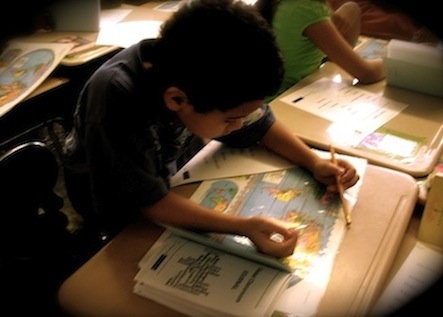
“Andorra? A country? Really?” said a student in Mr. Swander’s 6th grade class at MS 390 on October 23, 2009. Global Guide Natali Martins, a Fulbright student studying at Teachers College, replied “yes there is, can you guess where it’s located on the map?” Students feverishly attempted to locate Andorra on a digital map, but could not find it and began to name all the continents. Finally a student said “Europe!!!” and from here, Natali took the students on a journey to a far away nation without leaving the walls of room 601.
To begin, students explored ‘cultural identity’ through an interactive activity called Cultural Diversity & Cultural Understanding.Each student paired up with a partner and filled out a Venn diagram with characteristics they had in common and characteristics that were different among them (for instance gender, phenotype, languages, tastes, backgrounds, experiences, family, heritage, dreams, projects, religion, etc.) To their surprise, the students had many things in common with one another that they did not know - even after being in the classroom together for almost two months!
To provide students with a rich cultural background on Andorra, Natali discussed the geographic composition, population size and language diversity of her small country. Natali presented students with several beautiful pictures of Andorra in a thoughtful manner; she designed every power point slide with a question and provided students with a choice of three answers.Students had to choose the right answer in order to move onto the next slide. Students saw pictures of various parts of Andorra, which they compared to New York City and other cities around the world.
To conclude her presentation, Natali introduced the class to an important tradition in Andorra called Diada de San Jordi, which is very similar to the American tradition of Valentines Day. Natali narrated a folk story connected to Diada de San Jordi through comics and asked the students to create a folk story from their culture through comic as a creative homework assignment.
Once again this October, Global Classroom had the great pleasure to participate to the ‘Principal for a Day’ event at P.S 241 in Brooklyn.For this special occasion, two Japanese graduate students at Teachers College Global Guides, Toshiko Takahashi and Makiko Yoshino, delivered workshops on the culture of their home country to three different classes of 5th graders.
After introducing themselves to the class and locating Japan on a colorful map, they led a hands-on activity around traditional Japanese paper folding, origami. Toshiko explained the signicance of this art as a symbol of peace and good luck, and the students’ eyes shined when she told them that a Japanese popular belief says that if they make one thousand paper cranes, their dreams will come true!
Since folding a crane is not easy to do and required concentration, it was a challenge for students, but they were great in helping each other.
Makiko made also a big impression on to the students by wearing a colorful kimono, the Japanese traditional dress. Makiko explained that her kimono would be considered a formal design in Japan, worn for a special occaision.Many of the accessories she wore belonged to her grandmother.
All of the students had a great time learning about Japan and the significance of origami.They were excited to take home their paper cranes.Makiko and Toshiko suggested the students give the cranes to “someone they love.”
Global Classroom is a program of One to World, a New York City-based non-profit. We train international students in college or graduate school to teach interactive workshops in NYC public schools about their countries and cultures.